Drought Watch Declaration
Drought Watch Declaration
Rivanna Authorities Issues Drought Watch – Albemarle County Residents Encouraged to Conserve Water
Due to below-normal rainfall across our area, the Rivanna Authorities has issued a Drought Watch for Albemarle County and the City of Charlottesville. The Albemarle County Service Authority (ACSA) encourages voluntary water conservation measures and adopt water-saving practices to help protect this valuable resource.
A Drought Watch is intended to increase public awareness that conservation of our drinking water is essential as declining stream and reservoir water levels indicate we may be experiencing an extended drought.
If reservoir water levels continue to decline, we may need to request implementation of mandatory water restrictions through the issuance of a Drought Warning.
How You Can Help Conserve Water
Small changes in your daily routine can make a meaningful difference. The Virginia Department of Environmental Quality recommends the following water-saving practices:
- Turn off the faucet while brushing your teeth and use a cup of water to rinse.
- Wash fruits and vegetables in a bowl or filled sink instead of under running water.
- If pre-rinsing dishes, fill the sink rather than letting the faucet run continuously.
- Repair leaking faucets and pipes. Even a slow drip can waste hundreds of gallons of water each month.
- Fix leaking toilets promptly. A leaking toilet can waste up to 200 gallons of water each day.
- Run dishwashers only when they are full and use water-saving settings whenever possible.
- Wash full loads of laundry and select the appropriate water level for each load.
- Take shorter showers and consider showering instead of taking baths.
- Turn off the faucet while shaving and use water collected in the sink for rinsing.
Business Resources
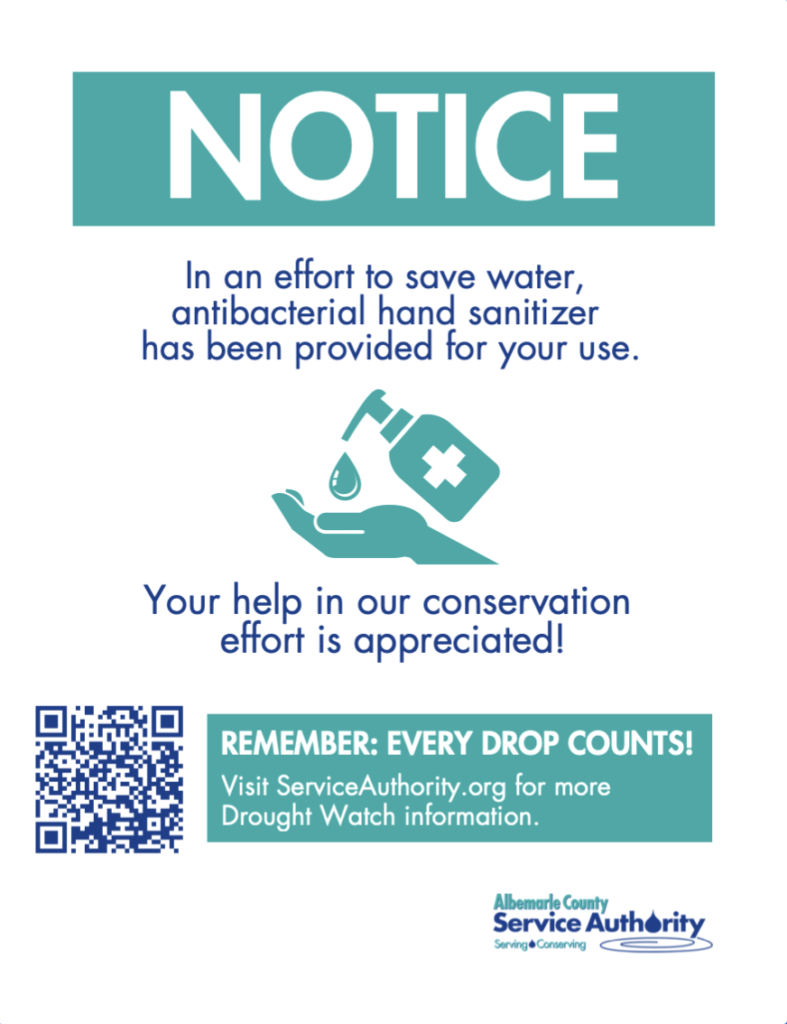
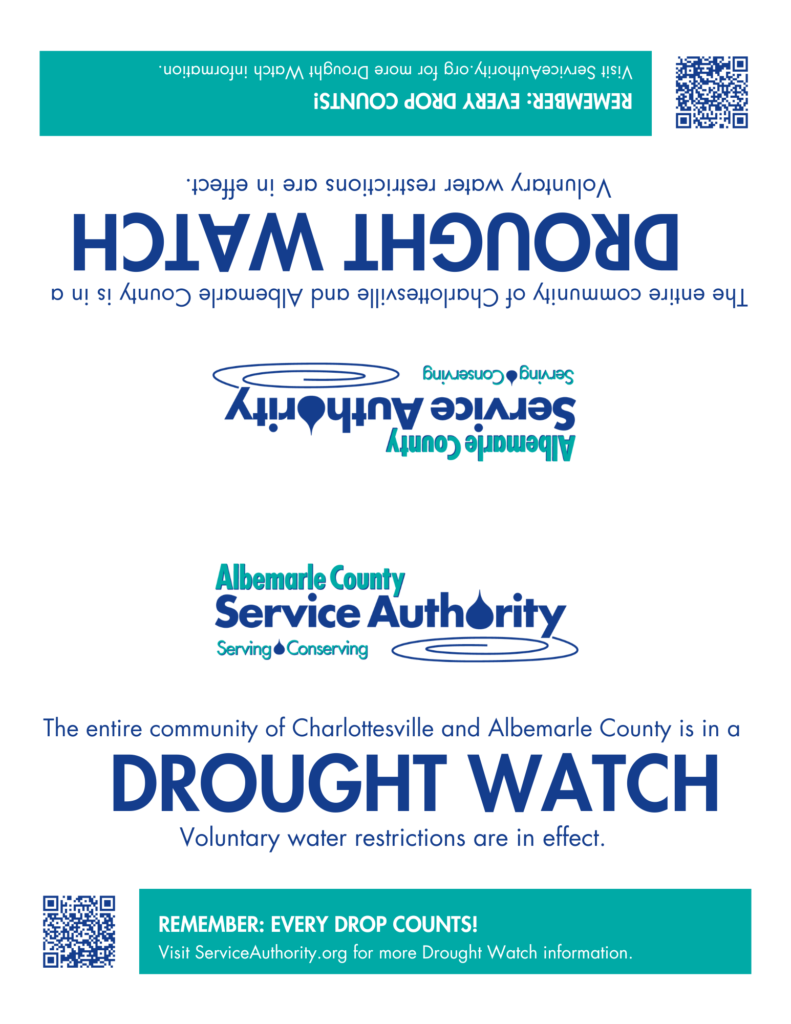
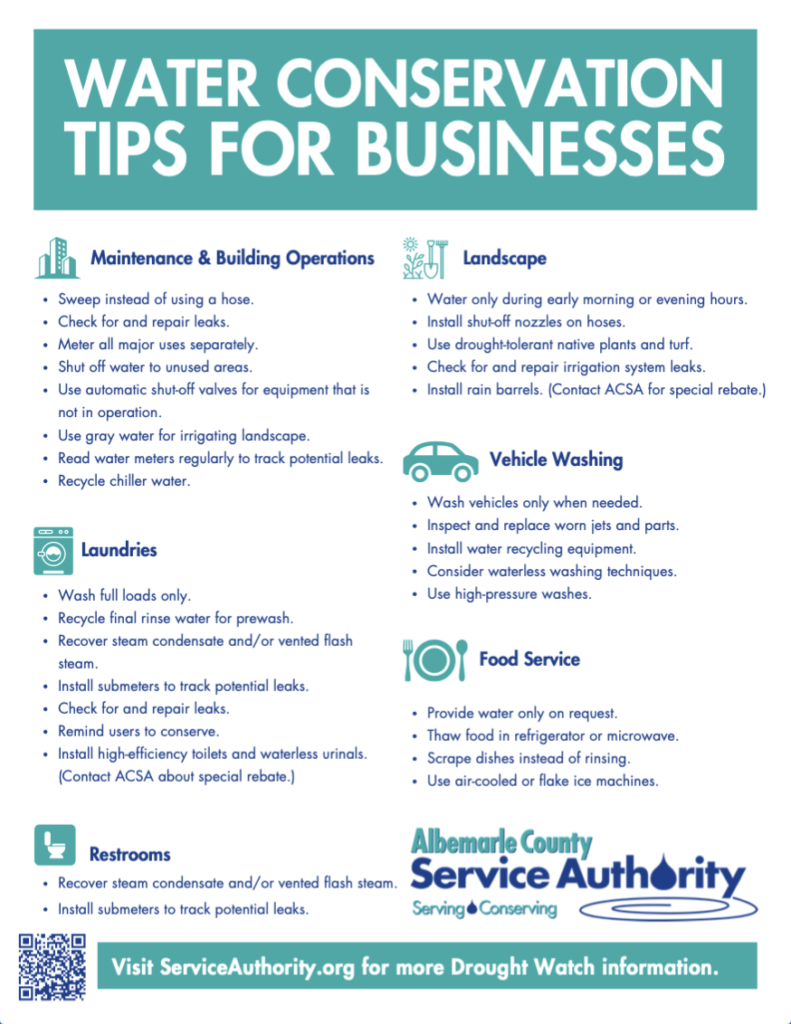
Drought Watch FAQs
What is a drought watch?
A drought watch means:
- Conserving water now can help prevent restrictions later.
- Water supplies are under increased stress.
- Voluntary water conservation is requested.
- Mandatory restrictions are not currently in effect.
How does this compare to a drought warning?
During a Drought Watch
Voluntary conservation
Early action
Community participation
During a Drought Warning
Mandatory restrictions
Emergency response
Required compliance
How you can help
Small changes by residents and businesses can make a meaningful difference in protecting our shared water supply.
Outdoors
- Water lawns, gardens and landscaping only when needed, between 9 p.m. and 10 a.m. to minimize evaporation.
- Use a watering can or a hose equipped with an automatic shut-off nozzle.
- Delay washing driveways, patios and sidewalks.
- Consider postponing filling pools or other large outdoor water uses if they aren’t essential.
Indoors
- Fix leaking faucets, toilets and irrigation systems.
- Run dishwashers and washing machines only with full loads.
- Take shorter showers when possible.
- Turn off the tap while brushing your teeth or shaving.
Why should I conserve water if there aren’t mandatory restrictions?
A drought watch is designed to encourage voluntary conservation before conditions worsen. By reducing water use early, our community can help protect reservoir levels and may reduce the need for mandatory restrictions if dry conditions continue.
What is a drought watch?
A drought watch is an early stage of drought response that encourages voluntary water conservation before mandatory restrictions become necessary. It signals that local water supplies are under increased pressure, but mandatory restrictions are not yet necessary. By conserving water now, residents and businesses can help preserve reservoir levels and help reduce the need for more restrictive measures later.
How long will the drought last?
A drought watch remains in effect until water supply conditions improve. While a single rainfall can help, it often takes multiple significant rain events over weeks or months for reservoirs to recover fully. Officials will continue monitoring conditions and provide updates as needed.
How serious is the situation?
A drought watch is a reminder that local water supplies are under increasing pressure, but it is not an emergency. By voluntarily reducing water use now, residents and businesses can help protect reservoir levels and possibly prevent mandatory restrictions later. Small changes across our community today can have a meaningful impact on preserving our water supply.
Will conserving water now really make a difference?
Yes. A drought watch is designed to encourage small actions before conditions become more severe. When residents and businesses conserve water together, the combined impact can help protect local water supplies and help avoid mandatory restrictions.
What will happen if voluntary conservation is not effective?
If dry conditions persist and water supplies continue to decline, officials may declare a drought warning, which includes mandatory water restrictions.
Can I water newly planted trees, shrubs or lawns?
Yes. During a drought watch, outdoor watering remains voluntary. Customers are encouraged to water responsibly by following the recommended watering hours and using only the amount of water needed to maintain healthy plants.
It rained recently. Why was a drought watch declared?
Despite the recent rainfall we have experienced, the precipitation has remained very localized to isolated parts of our area and has not significantly contributed to reservoir levels. Unfortunately, this lack of overall precipitation continues to push us closer to mandatory water restrictions.
Why can’t water be supplied from the Ragged Mountain Reservoir instead?
Ragged Mountain is our largest reservoir and is presently over 90% full, and continues to serve the role it was intended to play in the water supply plan. It supplies water to the Observatory Water Treatment Plant. The Observatory Plant is not able to serve the entire Urban Water System alone, and was designed to supplement the South Fork Rivanna Reservoir and Water Treatment Plant. Under normal operations the Urban System (ACSA and City of Charlottesville) is supplied by 80% production from South Fork and 20% production from Observatory. That has been recently shifted as we got into the drought to closer to 60-40%.
Why wasn’t a drought watch declared sooner?
Through careful planning and improvements made, our system’s reservoirs have, until very recently, remained 100% full. The RWSA has been closely monitoring reservoir levels, stream flows and operational demands and has observed drops in reservoir levels. We currently have an adequate public drinking water supply for our community as our reservoirs are over 90% full. However, with several months of hot and dry weather ahead of us, we are encouraging public water users to conserve as much as possible.
Summary
Every drop counts, and even small conservation efforts can help preserve our community’s water resources during dry conditions.
For additional drought preparedness and water conservation tips, visit https://www.ready.gov/drought or https://serviceauthority.org/water-conservation.
The Albemarle County Service Authority will continue to monitor conditions closely and provide updates as they become available. Thank you for doing your part to help conserve water and protect our community’s water supply.

Please join us on Thursday, October 15, 2026, at 9:00AM for our monthly Board of…
Please join us in congratulating our latest employee of the month, Charles DaCosta! Charles serves…
Albemarle County Service Authority will be closed on Friday, October 16, 2026 from 12-2PM for…
Please join us on at 9:00AM for our monthly Board of Directors meeting. You can…
Please join us in congratulating our latest employee of the month, Dwayne Shifflett! Dwayne serves…
 English
  Spanish